Can your accountant tell you which retainer lost money last month? If not, you're in good company, and it probably isn't their fault. Most accountants are trained to keep the books accurate and file returns on time, and plenty of them do that well.
What they often can't show you is the margin leak underneath. Hours burn past scope, freelancer costs never get billed back, and cash feels tight in the same month revenue went up. A general accountant records what happened. Accountants for creative agencies show you why it happened, and on which client.
We see this with digital marketing agencies constantly. It usually traces back to hiring for credentials alone, when agency experience matters just as much and is far harder to spot from a proposal.
TL;DR Quick Answers
Accountants for Creative Agencies
Accountants for creative agencies go beyond bookkeeping and tax filing. They show agency owners where profit is made and lost, client by client and retainer by retainer, so leadership can make growth decisions with confidence.
What they track: project margins, retainer burn rates, team utilization, unbilled work, and pass-through costs like ad spend and freelancer fees.
How they differ from generalists: a general accountant reports totals, while an agency accountant uses job costing to find margin leaks before they show up in cash flow.
Credentials to look for: a CPA or enrolled agent for tax work, plus current agency clients and hands-on experience with tools like QuickBooks, Harvest, and Gusto.
When agencies need one: once cash feels tight despite rising revenue, or when hiring and pricing calls start running on gut feel.
Biggest red flag: an accountant who talks about taxes but never about margins.
Top Takeaways
The best accountants for creative agencies track project margins, retainer burn, and utilization, along with taxes.
Match the role to your stage, from a bookkeeper for the basics to a fractional CFO once growth planning matters.
Before hiring, ask how a candidate tracks profitability by client and handles pass-through media spend.
Cash-basis books with no project reporting and no current agency clients are both strong warning signs.
A good agency accountant turns monthly numbers into confident decisions about hiring and which clients to keep.
What Makes Agency Accounting Different
Agencies make or lose money one retainer at a time, which means an accountant who only reads year-end totals misses the margin leaks that matter most.
Why Generalist Accountants Miss Agency Problems
Most small-business accounting assumes revenue shows up in a fairly steady stream. Yours probably doesn't. In a single month you might bill four retainers, two fixed-fee projects, a round of hourly overages, and a chunk of ad spend that goes straight back out to Google and Meta.
Lump all of that into one revenue line and the trouble hides in plain sight:
Scope creep. The team puts 60 hours into a 40-hour retainer, and nobody notices until margins dip.
Unbilled time. Hours logged in Harvest or QuickBooks Time never reach an invoice.
Pass-through costs. Ad spend and freelancer fees make revenue look bigger while they pull cash out the door.
Freelancer compliance. Every contractor means a W-9, a classification call, and possibly a year-end 1099.
That rarely comes down to anyone doing a bad job. The books simply weren't set up to give you that kind of visibility. If billing structures are part of the confusion, our guide to agency compensation models breaks them down.
Qualifications That Matter
The credential you need depends on how big you are and what you want the numbers to do for you.
Bookkeeper: Handles transaction entry, reconciliations, invoicing, and bill pay. A good fit for early-stage agencies with simple billing.
Enrolled Agent (EA): Prepares federal returns and represents you before the IRS. Useful when tax compliance is the main need.
Certified Public Accountant (CPA): Covers tax planning, financial statements, reviews, and audits. Growing agencies with more complex reporting usually need one.
Fractional CFO: Builds forecasts, analyzes margins, and plans pricing, hiring, and growth. Most valuable once you're scaling past a few million in revenue or thinking about a sale.
Most agencies benefit from a mix of professional accounting services that provide better financial visibility, stronger cash flow management, and greater confidence in business decisions. The setup we see most often pairs monthly bookkeeping and reporting with a CPA for tax filing, then brings in fractional CFO support when headcount starts climbing. This approach helps creative agencies stay financially organized, protect profitability, and plan for sustainable growth.
Skills and Experience to Look For
A license tells you someone passed an exam, but agency experience is what lets them help you lead clearly. Look for:
Job costing, so time and expenses are tracked against each client, project, and retainer.
Accrual accounting, which matches revenue to when the work happens instead of when cash lands.
Fluency in agency KPIs like utilization, retainer burn rate, project margin, and healthy agency profit margins.
Pipeline-driven forecasting that maps signed and expected work against payroll.
Hands-on time with your tools, whether that's QuickBooks, Harvest, HubSpot, Gusto, BILL, or Ramp.
A clear contractor workflow for W-9 collection, worker classification, and 1099 filing.
Questions to Ask Before You Hire
You'll learn more in a 30-minute interview than from any proposal. Ask these and listen for specifics.
How many marketing or creative agencies do you work with right now? A good answer includes a number and the kind of agencies they serve.
How would you track profitability by client and by retainer? You want to hear about job costing and time-tracking integration, not "we'll review the P&L."
What would you report to me every month? Utilization, project margin, and cash runway should come up without you prompting them.
How do you handle pass-through media spend? It should sit apart from your fee revenue so margins aren't overstated.
Which time-tracking and project tools have you connected to QuickBooks? Listen for actual product names.
How quickly do you close the month? Most agencies need clean numbers within two to three weeks.
Who files our taxes, and who advises on strategy? Get clear on whether that's one person or a coordinated team.
Teams that specialize in creative services accounting usually have these answers ready, because retainer burn, project margins, and contractor payments are already part of their monthly close.
Red Flags to Watch For
Be cautious with an accountant who:
Talks about taxes but never about margins
Can't explain utilization or retainer burn without looking it up
Keeps your books on a cash basis with no project-level reporting
Has no current agency clients or references
Routinely sends financials a month or more late
Any one of these deserves a follow-up question. Two or three together usually mean the fit is wrong, even if the person is perfectly competent at general accounting.
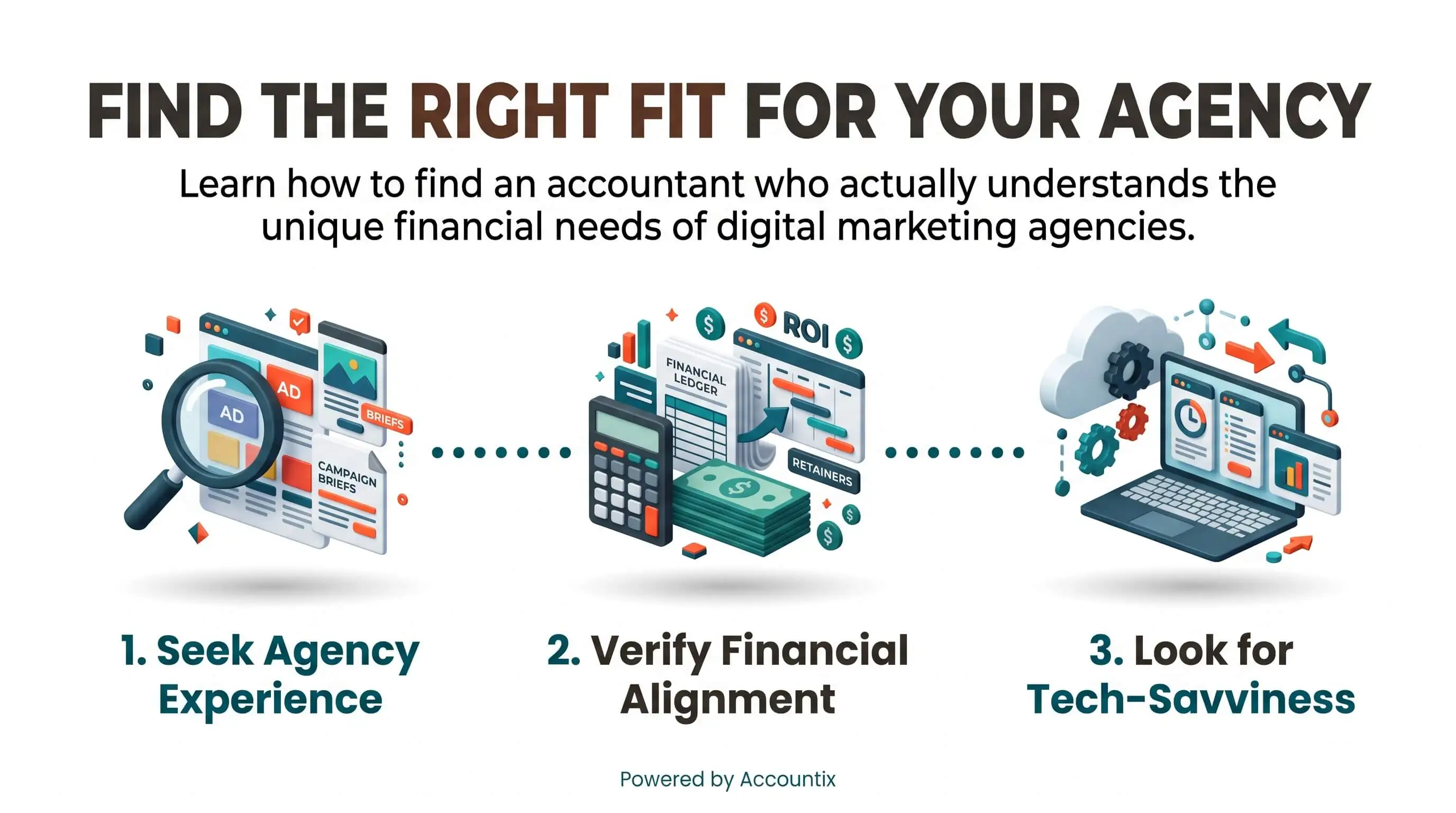
"When a founder tells us cash feels tight even though revenue is up, we nearly always find the same two things. A couple of retainers have been running past their hours for months, and freelancer costs never made it back onto an invoice. The books were accurate. They just weren't built to show that. Once we break profitability out by client and track retainer burn every month, the conversation changes. Leadership stops guessing about who to hire or which accounts to renegotiate, and starts making those calls with the numbers in front of them."
7 Essential Resources
Each of these is free, and most come straight from the agencies that license or regulate accountants.
CPAverify pulls license data from state boards of accountancy into one national lookup. You can check a CPA's license status and any disciplinary history in one place.
California Board of Accountancy is where Los Angeles agencies can verify a California CPA or firm and see any enforcement actions.
IRS: Enrolled Agent Program explains the EA credential, the highest the IRS awards, and links to its status verification tool.
IRS: About Form 1099-NEC has the current form and instructions for reporting freelancer and contractor payments.
IRS: Independent Contractor or Employee? lays out the behavioral, financial, and relationship tests for classifying freelancers.
SBA: Manage Your Business compares accrual and cash accounting and explains when a CPA, bookkeeper, or online service makes sense.
BLS: Accountants and Auditors covers what accountants do and what they earn in the U.S., which helps when you're pricing an in-house hire.
3 Statistics
The average digital agency kept about 13% as after-tax net margin in 2025, down from a long-run average near 15%. Studios under 10 people averaged about 19%, while agencies with 50 or more employees averaged about 8%. (Promethean Research, 2026 State of Digital Services, via Agiled)
Margin tends to shrink as you add people unless someone is watching it closely. Monthly project and retainer reporting is how you catch the slide early.
For payments made on or after January 1, 2026, the federal Form 1099-NEC threshold rose from $600 to $2,000 per payee, with inflation adjustments in later years. (Anchin, Block & Anchin)
Agencies that lean on freelancers should update their AP process now. Some states may hold onto the old $600 threshold [VERIFY], so your accountant needs to track both.
Accountants and auditors held about 1.6 million U.S. jobs in 2024, with a median annual wage of $81,680. (U.S. Bureau of Labor Statistics)
That's the salary alone, before benefits and payroll taxes. For many agencies, outsourced or fractional support gets them agency-specific expertise for less than one full-time hire.
Final Thoughts and Opinion
If we had to rank it, we'd hire for agency fluency first, credentials second, and price last.
Credentials still matter. You want a licensed CPA or an enrolled agent signing your returns. But a license won't tell you whether someone can spot a retainer running at a loss or forecast cash against next quarter's hiring plan. That kind of judgment comes from working inside agency books month after month.
Price is a fair concern, especially for smaller shops. We'd just point out that the cheapest option often turns out to be the most expensive once you count the margin you never saw leaving.
The agencies we see doing well treat accounting as a monthly management tool rather than a year-end chore. Their numbers tell them which clients deserve more attention and when it's safe to hire. Getting there is mostly a matter of choosing an accountant who knows what to look for.
Still deciding whether outside help makes sense at all? Our piece on the benefits of outsourcing agency accounting lays out that case.
Frequently Asked Questions
What qualifications should an accountant for a digital marketing agency have?
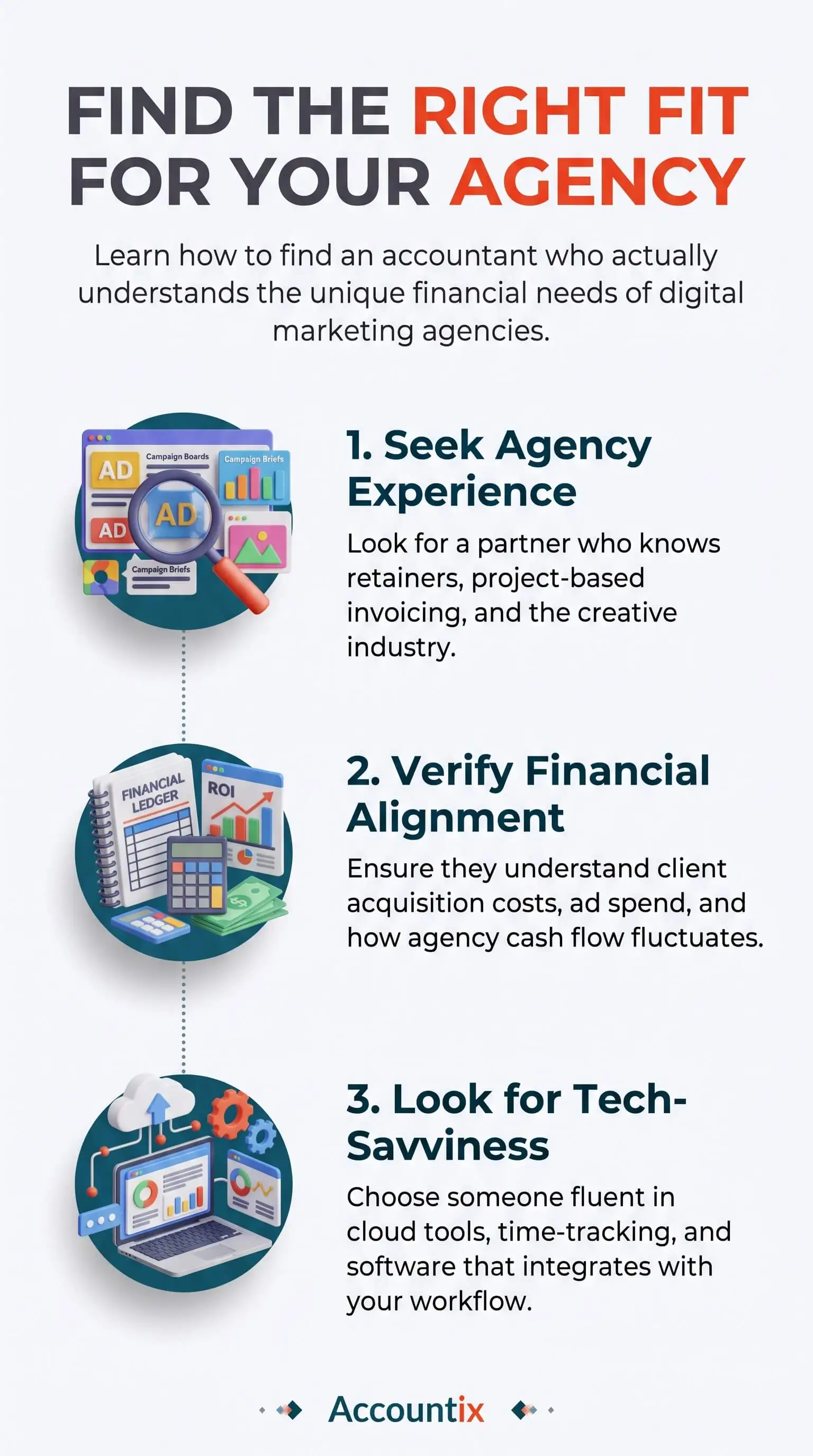
A CPA or enrolled agent should handle your tax work, but agency experience matters just as much. Look for someone who understands job costing, accrual accounting, and retainer and project billing. Ask how many agencies they work with now and what they report to those clients each month.
Do I need a CPA, a bookkeeper, or a fractional CFO?
That depends on your stage. A bookkeeper keeps daily records clean, and a CPA or EA handles tax planning and filing. A fractional CFO adds forecasting, pricing, and growth planning. Plenty of agencies start with bookkeeping plus a CPA, then add CFO support as the team grows.
What KPIs should an agency accountant report on?
At minimum you should see project margin, retainer burn rate, team utilization, net profit margin, and cash runway. A standard profit and loss statement on its own won't tell you which clients are making you money.
How do accountants handle pass-through ad spend?
A qualified accountant keeps media spend and other reimbursable costs separate from your agency's fee revenue. Without that separation, margins look healthier than they are and cash flow gets harder to predict. Ask any candidate to walk you through their approach.
When should an agency switch to a specialized accountant?
It's usually time once founders are spending hours on cash flow, hiring decisions run on gut feel, or nobody can say which clients are profitable. Our guide to the signs your agency needs outside accounting help covers more of them.
Does the 2026 Form 1099 change affect my agency?
It does if you pay freelancers. Starting with 2026 payments, the federal Form 1099-NEC threshold moved from $600 to $2,000 per payee. Some states may keep a lower limit [VERIFY], so confirm your obligations with your accountant.
Find an Accountant Who Speaks Agency
Take the questions above to your current accountant and see what comes back. If the answers get vague the moment you ask about margins or retainer burn, that's a signal worth acting on.
A 30-minute conversation with a creative services accounting team can show you where profit is slipping and what clearer monthly numbers would look like. It's a no-obligation conversation built around clarity rather than a sales pitch, so you'll leave knowing your next step either way.


