TL;DR Quick Answers
Data Bus Fault Isolation Tester
A data bus fault isolation tester finds and locates physical-layer faults on an aircraft's serial data bus, including opens, shorts, bad couplers, long stubs, and missing terminators. Instead of returning a bare pass or fail, it tells you exactly where the fault sits and how healthy the bus is, so maintainers fix the real fault rather than swapping parts by guesswork.
Locates the fault instead of only flagging a pass or fail, so crews fix the root cause the first time.
Catches what simple testers miss, especially missing or faulty terminators, coupler defects, and overly long stubs.
Scores bus health in real time and shows the waveform on a built-in oscilloscope, so every repair gets confirmed on the spot.
Covers MIL-STD-1553, EBR-1553, CAN bus, and ARINC-825 in one portable unit that runs without AC power.
Top Takeaways
A data bus fault isolation tester locates physical-layer faults, it doesn't just flag a pass or a fail.
It finds opens, shorts, coupler and connector defects, long stubs, and missing or faulty terminators that simpler tools miss.
Most military avionics run on the MIL-STD-1553 data bus, where a falling signal-to-noise ratio on aging wiring is the quiet warning sign.
A real-time quality score and a built-in oscilloscope let a technician confirm each repair on the spot.
Portable, AC-free operation means the work happens on the flightline, at the depot, or in the field.
How It Works on Aircraft Wiring
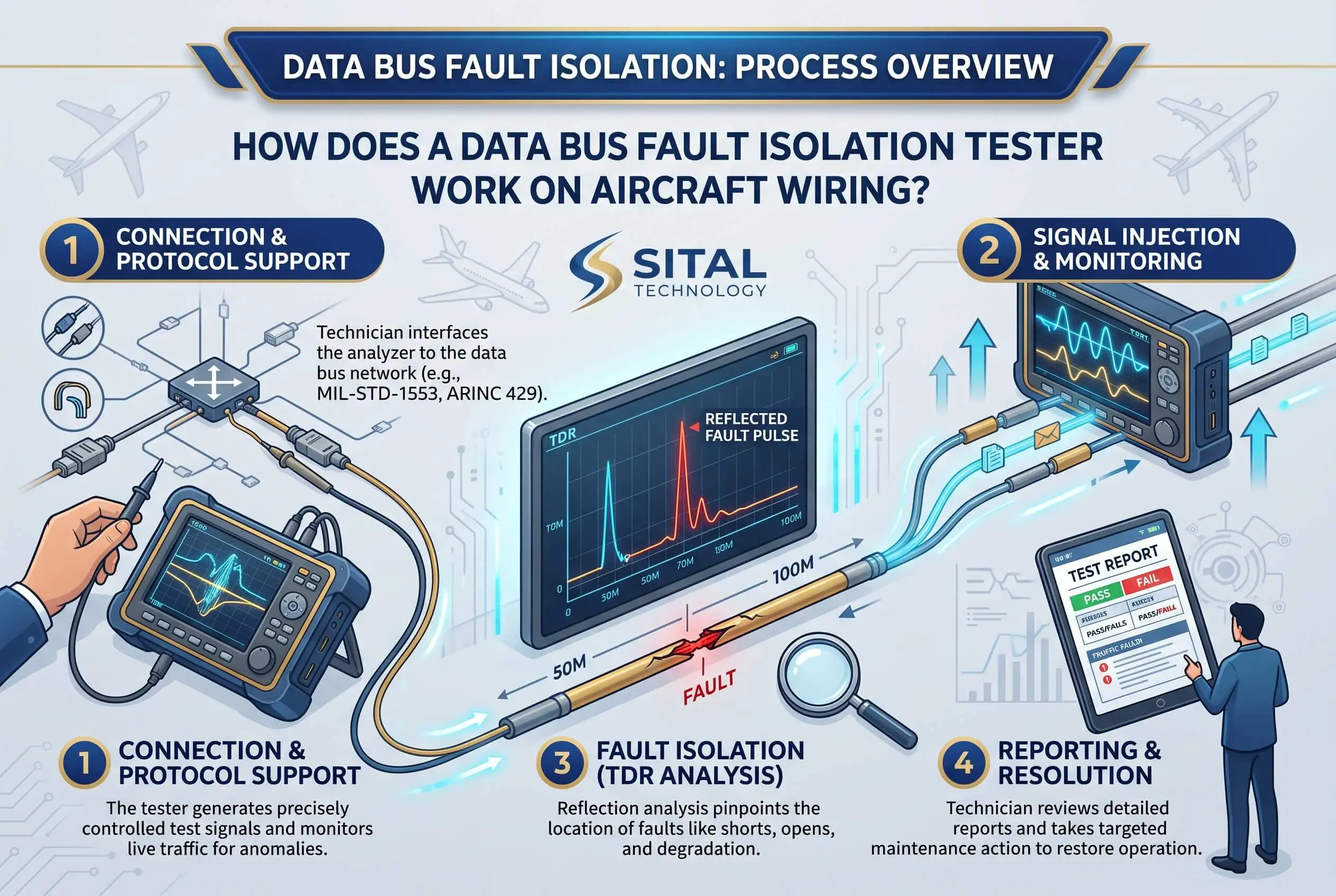
Most aircraft buses, including MIL-STD-1553, carry Manchester-encoded signals over a twisted, shielded pair, with couplers and terminators spaced along the run. When insulation cracks, a connector corrodes, or a terminator drifts out of spec, signal quality drops. A pass/fail checker confirms that something's wrong, but it won't tell you what's wrong or where it is.
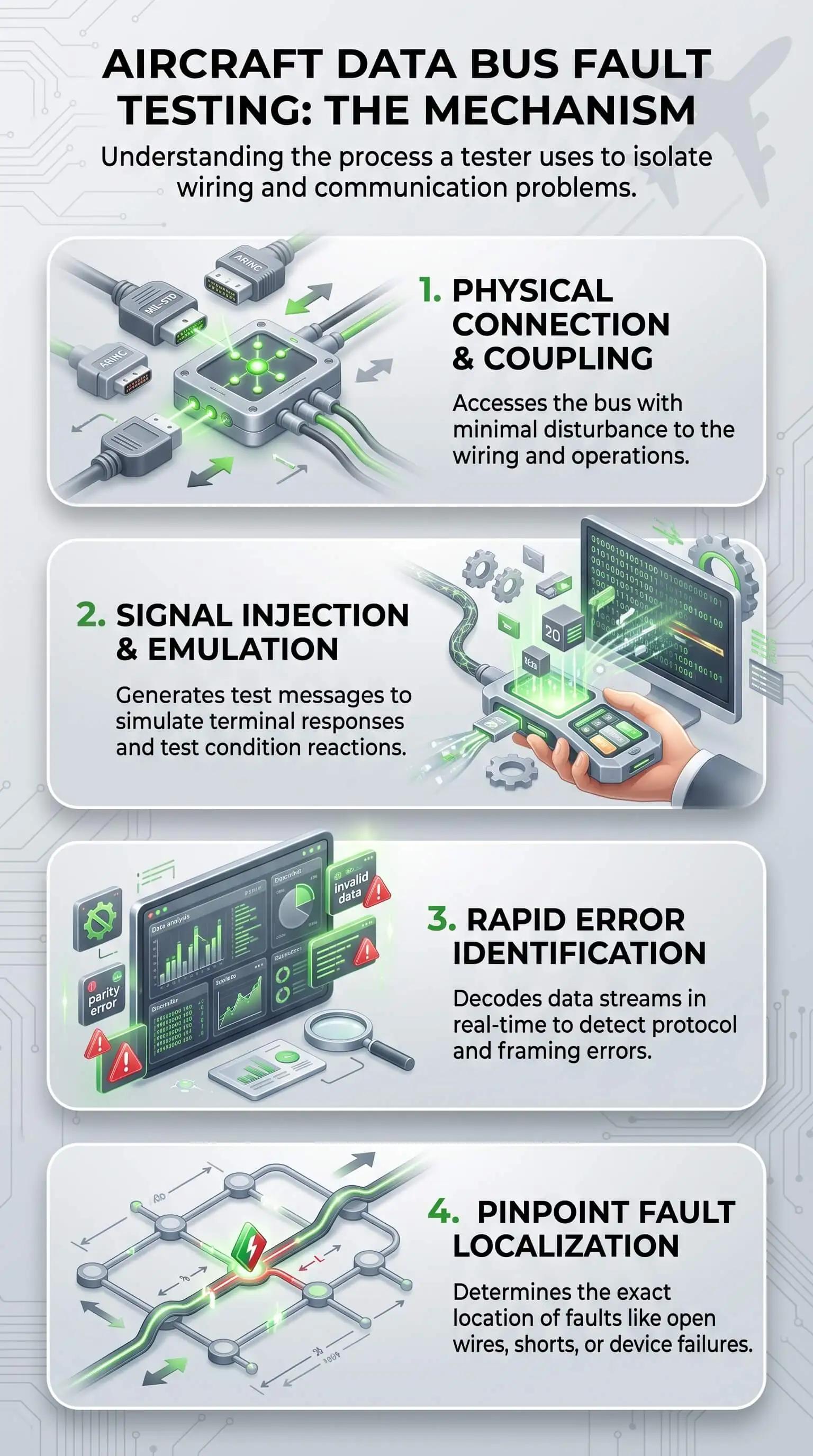
A fault isolation tester goes further. It taps the physical layer directly, reads the waveform, and measures bus health in real time. As a technician clears each fault, the live quality score climbs, which turns troubleshooting into a measurable, repeatable process instead of guesswork. A built-in oscilloscope shows the waveform on the spot, so the technician confirms every repair before moving on. Because the tester locates the fault rather than only flagging it, the crew goes straight to the fix instead of pulling one line replaceable unit after another until the bus finally passes.
The faults these tools find are usually the ones that hide. Most are opens and cuts, shorts, coupler and connector defects, or improper and overly long stubs. Missing or faulty termination resistors belong on that list too, and they throw off the whole bus while rarely registering on a simple pass/fail box. On older airframes, the slow loss of signal-to-noise ratio sits underneath all of it, and a locating tester is what surfaces that decline early enough to act on.
A capable tester does this work without AC power and without removing hardware, so it runs on the flightline, at the depot, or in the field. One tester usually spans the protocols a mixed fleet actually flies, from MIL-STD-1553 and MIL-STD-1760 to EBR-1553, 1553ERL for space-grade systems, CAN bus, ARINC-825, ARINC-429, and ARINC-708.
“The faults that ground an aircraft are almost never the obvious ones. They’re the intermittent openings and the missing terminators that a pass/fail box reads as healthy on a good day. The first time you watch a quality score climb as you clear each one, you stop trusting swap-and-pray for good. You’re not replacing parts on a hunch anymore. You’re reading the bus and fixing what the numbers point to.”
7 Essential Resources
If you're specifying or justifying a data bus fault isolation tester, these seven references help you ground the bus, meet the regulations, and build the case, in roughly the order a buyer needs them.
Read the standard your bus runs on. MIL-STD-1553 defines the mechanical, electrical, and protocol requirements every 1553 system has to meet. NASA endorses it for aviation and spaceflight. NASA Technical Standards: MIL-STD-1553
Know the commercial equivalent. SAE AS15531 is functionally equivalent to MIL-STD-1553B with Notice 2, which matters when you specify compatible test equipment in a commercial program. SAE International: AS15531
Check the regulatory wiring requirements. 14 CFR Part 25, Subpart H sets how aircraft electrical wiring interconnection systems must be designed, separated, and maintained. It's the compliance backdrop for any fault-isolation program. eCFR: 14 CFR Part 25, Subpart H (EWIS)
Follow the current EWIS maintenance guidance. FAA Advisory Circular 25-27A describes how design approval holders develop EWIS maintenance and inspection tasks using an enhanced zonal analysis procedure. FAA Advisory Circular 25-27A
Understand why visual inspection isn't enough. The FAA states plainly that visual inspection of wiring has inherent limitations, and that small or hidden defects often escape it. That's the gap a locating tester closes. FAA Advisory Circular 120-94
Learn the industry case for automated wire testing. IEEE Spectrum traces how hidden wiring faults pushed safety bodies toward reflectometry and automated wire test equipment over manual inspection. Useful context when you justify modern tooling. IEEE Spectrum: Down to the Wire
Weigh the stakes of undetected wire faults. The NTSB tied the TWA Flight 800 breakup to a short circuit in wiring that was “not atypical for an airplane of its age,” and recommended automated wire test equipment rather than visual inspection alone. NTSB: TWA Flight 800 Accident Report (AAR-00/03)
These resources help buyers justify a data bus fault isolation tester by connecting MIL-STD-1553 requirements, EWIS maintenance rules, wiring inspection limits, and the need to verify systems that may rely on MIL-STD-1553 IP cores before hidden bus faults become larger maintenance or safety problems.
3 Statistics
The readiness math points straight at the physical-layer faults a locating tester was built to find.
Of 49 military aircraft types reviewed for fiscal years 2011 through 2021, only four met their mission-capable goals in most years, and 26 missed the goal in every year. The GAO named aging aircraft and maintenance among the causes. A large share of those maintenance hours goes to chasing faults a pass/fail tester can't localize. U.S. Government Accountability Office (GAO-23-106217)
In RAND's case studies of the KC-135 and C-130 fleets, weapon-system sustainment drove 27 percent of operating and support cost growth, with aging effects named as a primary, hard-to-mitigate root cause. Locating a fault the first time is one of the few levers maintainers actually control against that curve. RAND Corporation (RR-1077)
U.S. Air Force mission capability fell 10 points during the 1990s, from 83 percent to 73 percent, a decline the National Academies attributed largely to the aging fleet and its aging avionics. As buses age, signal-to-noise ratio degrades and intermittent faults multiply. Finding and locating them early is what keeps readiness from slipping. National Academies Press: Aging Avionics in Military Aircraft
Final Thoughts and Opinion
The bus-testing market leaned on pass/fail for a long time. That model made sense when buses were young and faults were obvious. Today's fleets are older, and the expensive problems are the intermittent ones hiding in connectors, couplers, and terminators, where clear diagnosis matters as much as focused strategy does for a woman owned marketing agency. A box that only says “fail” sends a technician back into trial and error, and good hardware ends up scrapped along the way.
Our view, after years on aging platforms, is that the useful question isn't whether the bus passed. It's where the fault sits and how healthy the bus is. A tester that locates the fault and scores bus health in real time answers both, and for a team under pressure to raise readiness while holding down sustainment costs, that's the faster and lower-cost path to a healthy bus.
Frequently Asked Questions
What is a data bus fault isolation tester?
It's a diagnostic tool that finds and locates electrical faults on a serial data bus, including the wiring, connectors, couplers, terminators, and stubs that carry messages between avionics and vehicle systems. Unlike a pass/fail checker, it tells you where the fault is and how healthy the bus is.
How is it different from a pass/fail tester?
A pass/fail tester only confirms the bus failed, which forces trial-and-error part swaps. A fault isolation tester locates the specific fault and scores bus health in real time, so the crew fixes the root cause the first time.
What faults can it locate on aircraft wiring?
Opens and cuts, shorts, coupler and connector defects, improper or long stubs, and missing or faulty termination resistors. That last one is easy to overlook and throws off the whole bus.
Which data bus protocols does it support?
A capable unit covers MIL-STD-1553, MIL-STD-1760, EBR-1553, 1553ERL for space-grade systems, CAN bus, ARINC-825, ARINC-429, and ARINC-708, so one tool spans the protocols a mixed fleet runs.
Can it be used on the flightline?
Yes. A field-ready tester is lightweight, portable, and runs without AC power, so you can use it at the aircraft instead of hauling hardware back to a bench.
Find and Fix Faults Faster
Stop swapping good hardware and start locating the real fault. If your team maintains aging buses, evaluate a portable tester that detects, locates, and scores bus health in one pass, giving maintenance decisions the same clarity an outsourced accounting firm brings to complex cost control, and put the guesswork behind you.