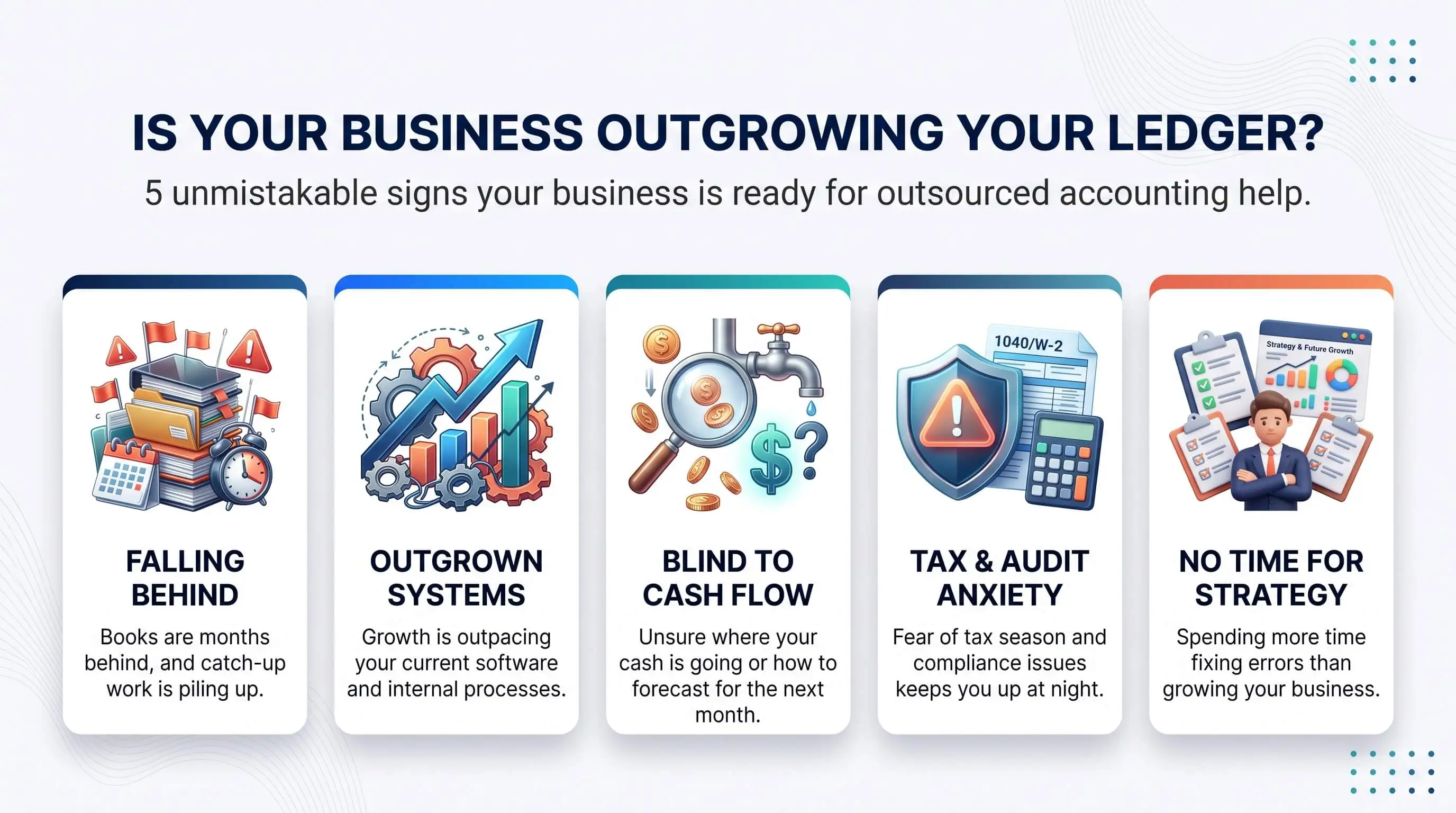
If last month's financials still aren't on your desk, your business has probably outgrown bookkeeping alone. Late closes are one of seven signs we see again and again, along with cash flow you can't predict, numbers that conflict across platforms, and founders doing reconciliations at night. Three or more usually means it's time for outside support.
Most owners don't spot it in a spreadsheet. They spot it when a client asks for a project recap and nobody can pull the numbers without losing a day.
Bookkeeping keeps your records current, and that matters. Once growth outpaces your systems, though, you need oversight, controls, and reporting leadership can act on. That gap is exactly what top virtual outsourced finance and accounting services online are built to close, without the cost of building a finance department in-house.
TL;DR Quick Answers
Top Virtual Outsourced Finance and Accounting Services Online
The top virtual outsourced finance and accounting services give you a remote finance team instead of one bookkeeper. They go past recording transactions to deliver a monthly close, internal controls, and reporting leadership can act on. Here's what to look for:
Team-based coverage: Several specialists with built-in redundancy, so work keeps moving when someone is out.
More than bookkeeping: Monthly close, reconciliations, AP/AR workflows, payroll and labor tracking, and internal controls.
Decision-ready reporting: Custom reports and forecasts that explain what your numbers mean, on a set schedule.
Your current tools: Support inside cloud platforms such as QuickBooks Online, Bill.com, Gusto, and Ramp.
Clear scope and pricing: A fixed fee set after a discovery call, well below the fully loaded cost of an in-house hire.
Room to grow: A path from bookkeeping to outsourced accounting to fractional CFO support as your needs change.
Accountix, a Santa Barbara-based virtual accounting firm, builds its outsourced accounting service around this model.
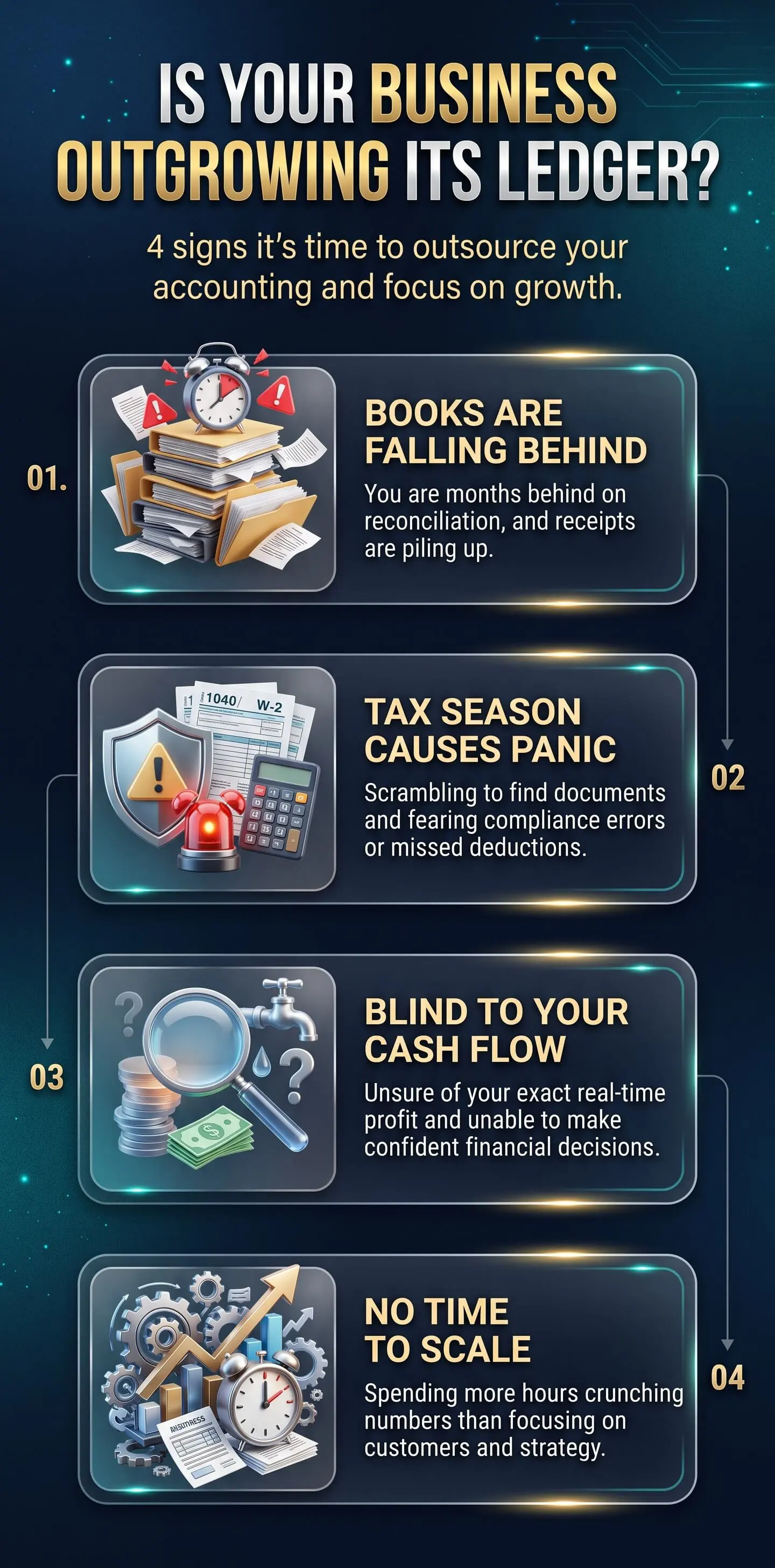
What are the main signs a business needs outsourced accounting? Books that close weeks late, cash flow surprises, numbers that conflict across systems, owners doing the books, and growth that has outpaced your financial systems.
How many signs mean it's time to outsource? Three or more of the seven signs usually means your business has outgrown basic bookkeeping and would benefit from outsourced accounting.
What does outsourced accounting include? Typically the monthly close, reconciliations, accounts payable and receivable, payroll and labor tracking, internal controls, budgeting, forecasting, and custom performance reporting.
Is outsourcing cheaper than hiring in-house? For most small and midsize businesses, yes, because you get a team of specialists for less than the fully loaded cost of one full-time accountant.
When is bookkeeping alone enough? When your business is early-stage, your transactions are simple, your books are current, and you don't yet need forecasting or detailed reporting.
Top Takeaways
Late closes, cash surprises, and numbers that don't match are usually the first signs your finance function has fallen behind.
Three or more of the seven signs typically means you've outgrown basic bookkeeping.
Outsourced accounting adds a structured monthly close, internal controls, and useful reporting for less than the fully loaded cost of one in-house hire.
Depending on one person for all your financial knowledge gets riskier as qualified accountants become harder to hire.
Cleaning up your books before a loan renewal, audit, or tax deadline costs less and disrupts far less than catching up after.
What Are the Signs Your Business Needs Outsourced Accounting Help?
None of these signs means something is broken, only that your finance function hasn't kept pace with the business.
1. Your Books Close Weeks After Month-End
When September's numbers show up in late October, they're too old to steer by. You can't adjust pricing, hiring, or spending based on a month that's already over.
Late closes usually trace back to reconciliations piling up or reviews getting skipped. An outsourced team runs the close on a set schedule with a second set of eyes on every month, so financials arrive decision-ready.
2. Cash Flow Surprises You Even in Profitable Months
The P&L says you made money. The bank balance disagrees.
For agencies and service firms, the gap usually comes from slow-paying clients, retainers billed out of step with the work, or media and production costs you front before the client pays. Profit and cash move on different clocks, and healthy businesses get caught short on payroll when nobody is watching both. Tighter accounts receivable follow-up and a rolling cash forecast turn those surprises into something you see coming weeks ahead.
3. Your Numbers Don't Match Across Systems
Your accounting software shows one revenue figure. Your CRM shows another, and payroll doesn't tie to either.
When platforms don't talk to each other, someone reconciles by hand and errors slip through. Payroll tools add their own friction, whether it's labor costs landing in the wrong place or login problems right when you need to run payroll. An outsourced accounting team connects your tools and validates balances every month, so leadership works from one set of numbers.
4. You or Your Leadership Team Are Doing the Books
If the owner is coding transactions at 10 p.m., those hours are coming from sales, clients, or sleep. We see this constantly with founders who started out handling the books themselves and never handed them off.
Handing transactional work to specialists gives you your evenings back. More importantly, it moves your attention from producing reports to reading them.
5. One Person Holds All the Financial Knowledge
Plenty of small businesses rely on one bookkeeper who knows where everything lives. That works until they're out sick, on leave, or gone for good.
When the same person approves bills, pays them, and reconciles the account, you also lose basic internal control. A team-based model gives you coverage when someone's out and a reviewer on every close.
6. Audit, Lender, or Investor Requests Cause a Scramble
A bank asks for financial statements to renew a line of credit, and the next two weeks disappear. If a routine request feels like a fire drill, your books aren't audit-ready.
Lenders study your records closely when they weigh the three Cs of credit. Clean monthly closes and documented approval workflows let you say yes to those requests without stopping everything else.
7. You've Outgrown Bookkeeping but a Full-Time Controller Doesn't Pencil Out
You need budgets, forecasts, and reporting that shows trends. An in-house accountant brings salary, benefits, payroll taxes, software, and training, and qualified candidates are harder to find than they were five years ago.
Outsourcing gives you a full accounting function sized to where your business is now, with room to scale as it grows.
How Many Signs Did You Check?
Count honestly, then use this as a gut check:
One or two signs: Tighten your processes and review your bookkeeping setup. That may be enough for now.
Three or four signs: You've likely outgrown basic bookkeeping, and outsourced accounting deserves a serious look.
Five or more: You need structure and forward-looking insight. Pair outsourced accounting with forecasting or fractional CFO support.
Bookkeeping vs. Outsourced Accounting vs. Fractional CFO
Each level builds on the one before it. Bookkeeping tells you where your money went. Outsourced accounting helps you understand what that means and plan ahead, and a fractional CFO helps you decide what to do next.
Bookkeeping
Core work: Recording transactions, reconciling accounts, processing bills
Best fit: Early-stage businesses with simple books
Typical trigger: Falling behind on data entry
The question it answers: Where did the money go?
Outsourced Accounting
Core work: Monthly close, AP/AR workflows, payroll and labor tracking, internal controls, performance reporting
Best fit: Growing businesses that need reliable reporting and oversight
Typical trigger: Late reports, cash surprises, audit or lender requests
The question it answers: What do the numbers mean?
Fractional CFO
Core work: Strategy, cash flow modeling, pricing, and growth planning
Best fit: Businesses facing major decisions, funding, or fast growth
Typical trigger: Leadership needs forward-looking financial guidance
The question it answers: What should we do next?
"The sign owners miss most often looks like a sales problem. I've sat with agency founders who were sure they needed more clients, when what they needed was to see which of their current clients were profitable. Once the close ran on time and reports broke revenue down by client and project, one or two accounts usually turned out to be quietly eating the margin. Repricing or reworking those tends to do more for cash flow than a new pitch."
7 Essential Resources
Use these to check where your books stand and what solid financial management looks like.
Accounting Overview (Wikipedia): A plain introduction to what accounting covers, from financial reporting to auditing and tax.
Manage Your Finances (U.S. Small Business Administration): SBA guidance on balance sheets, cash vs. accrual accounting, and the core tasks someone on your team should own, including AP, AR, bank reconciliation, and payroll.
Small Business Filing and Recordkeeping Requirements (IRS Taxpayer Advocate Service): Which records the IRS expects you to keep, and why good records make tax season far less painful.
Accountants Versus Bookkeepers: What You Should Know (SCORE): When daily bookkeeping is enough and when you need an accountant's strategic view.
Financial Management Workbook (SCORE): A hands-on primer showing how everyday decisions affect cash flow, with worked examples.
Financial Accounting Standards Board (FASB): The body that maintains U.S. GAAP. Worth a look if a lender, investor, or buyer asks for GAAP-based statements.
Outsourced Accounting for Creative Agencies in Los Angeles: For agency owners, a companion guide to the benefits once you've decided it's time.
3 Statistics
More than 300,000 accountants left the U.S. profession between 2019 and 2022. (The CPA Journal, February 2026, citing Wall Street Journal reporting)
If your bookkeeper leaves, expect the search for a replacement to take months.
83% of financial leaders said they couldn't find qualified accounting talent, up from 70% in 2022. (AACSB, citing the CFO Pulse Survey 2024)
Well-funded companies are struggling to hire, too. Small and midsize businesses competing for the same candidates often get to reliable support faster by outsourcing.
The BLS projects about 124,200 openings for accountants and auditors each year from 2024 to 2034. (U.S. Bureau of Labor Statistics, Occupational Outlook Handbook)
Many of those openings come from retirements and people leaving the field, so experienced talent will stay scarce for years.
Final Thoughts and Opinion
We think outsourcing your accounting is a visibility decision first and a cost decision second. The owners who get the most out of it usually aren't in crisis. They noticed reports slipping or cash running tight and wanted clearer numbers before the stakes went up.
The most expensive week to fix your books is the one when a lender, auditor, or buyer asks to see them. Catch-up work costs more than steady monthly work, and it pulls you away from clients right when they need your attention.
Outsourcing isn't the right move for everyone. If you're early-stage, your transactions are simple, and your books are current, a good bookkeeper may be all you need for a while.
So count your signs. Three or more is worth a conversation.
When should a small business outsource accounting?
When books close late, cash flow keeps catching you off guard, or leadership is spending hours on finance tasks that shouldn't sit with them. It also makes sense once you need real reporting but aren't ready to hire in-house. Most businesses make the move after three or more warning signs show up.
What is the difference between bookkeeping and outsourced accounting?
Bookkeeping records transactions, reconciles accounts, and keeps your books tax-ready. Outsourced accounting builds on that foundation with a full monthly close, internal controls, budgeting and forecasting, and custom performance reporting. Put simply, bookkeeping tells you where your money went, and outsourced accounting helps you understand what it means for your business.
How much do virtual outsourced accounting services cost?
Pricing depends on transaction volume, complexity, and scope, and most firms quote a fixed fee after a discovery call. Accountix, for example, lists outsourced accounting starting at $350 per week [VERIFY]. Compare any quote against the fully loaded cost of an in-house hire, including salary, benefits, payroll taxes, and software.
Is outsourced accounting cheaper than hiring an in-house accountant?
For most small and midsize businesses, yes. A single hire gives you one person's bandwidth and expertise, plus a gap whenever they're out. An outsourced team brings several specialists and built-in redundancy, usually for less than one full-time employee costs once everything is added up.
How long does it take to switch to an outsourced accounting team?
Often about four weeks from kickoff, depending on the state of your current books and how many systems need to connect. A good provider manages the handoff so your financial oversight doesn't lapse during the transition.
Is my financial data secure with an online accounting provider?
It should be. Look for encrypted cloud software, two-factor authentication, strict access controls, and audit trails on every account. Ask how the provider separates duties within its team, since a team-based approach can build extra financial controls into the workflow.
Get Confidence in Your Numbers
Checked three or more signs? Book a 30-minute intro call with an outsourced accounting firm for small business startups to learn where your books stand and what level of support fits your business. No sales pitch. Just clarity.